Pause carousel
Play carousel

A study carried out by Abertay University and St Johnstone FC has found that hamstring injuries - one of modern football’s most common issues – could be phased out with more targeted training.
The volume of high-speed running in modern football has increased in line with greater demands placed on professional players - but this has come at a cost, with hamstring injuries on the increase, sometimes sidelining key players for months.
In a world-first for sprint training analysis in football, Abertay and St Johnstone used near-infrared spectroscopy (NIRS) and GPS trackers to study the impact of sprinting on players’ leg muscles - with the aim of finding ways to lower the risk of hamstring injuries in the professional game.
The research, published in the open access journal Muscles, showed that the bicep femoris (located in the hamstring) recovers significantly more slowly than the rectus femoris (in the front thigh) during repeated sprints, and that there is a significant relationship between muscle oxygen use and sprinting performance.
Around 70% of hamstring injuries in professional football occur during linear, high-speed running – with the bicep femoris and rectus femoris the key muscles involved in sprinting.
The slower recovery of the bicep femoris muscle means that repeated high-speed activities are using a greater amount of anaerobic energy in the hamstrings, which is not sustainable for a long period of time. This means the hamstring will be fatigued before the quadricep muscle and may suggest conditioning of the bicep femoris does not meet the demands of the modern professional game.
Eight St Johnstone players - two central defenders, four midfielders and two strikers - took part in the study, completing two 30m sprints with only ten seconds of rest. NIRS was used to record muscle oxygenation during high-speed movements, alongside GPS units which gathered data on sprint speed.
While the players’ maximum speeds stayed the same, the time it took for the footballers to reach top acceleration dropped sharply in the second sprints; with the bicep femoris experiencing a much larger drop in oxygenation and recovering far more slowly than the rectus femoris.
The results suggest that the hamstring is more vulnerable to fatigue, potentially increasing injury risk during repeated high-intensity actions including counterattacking, defensive recovery runs, and pressing in football.
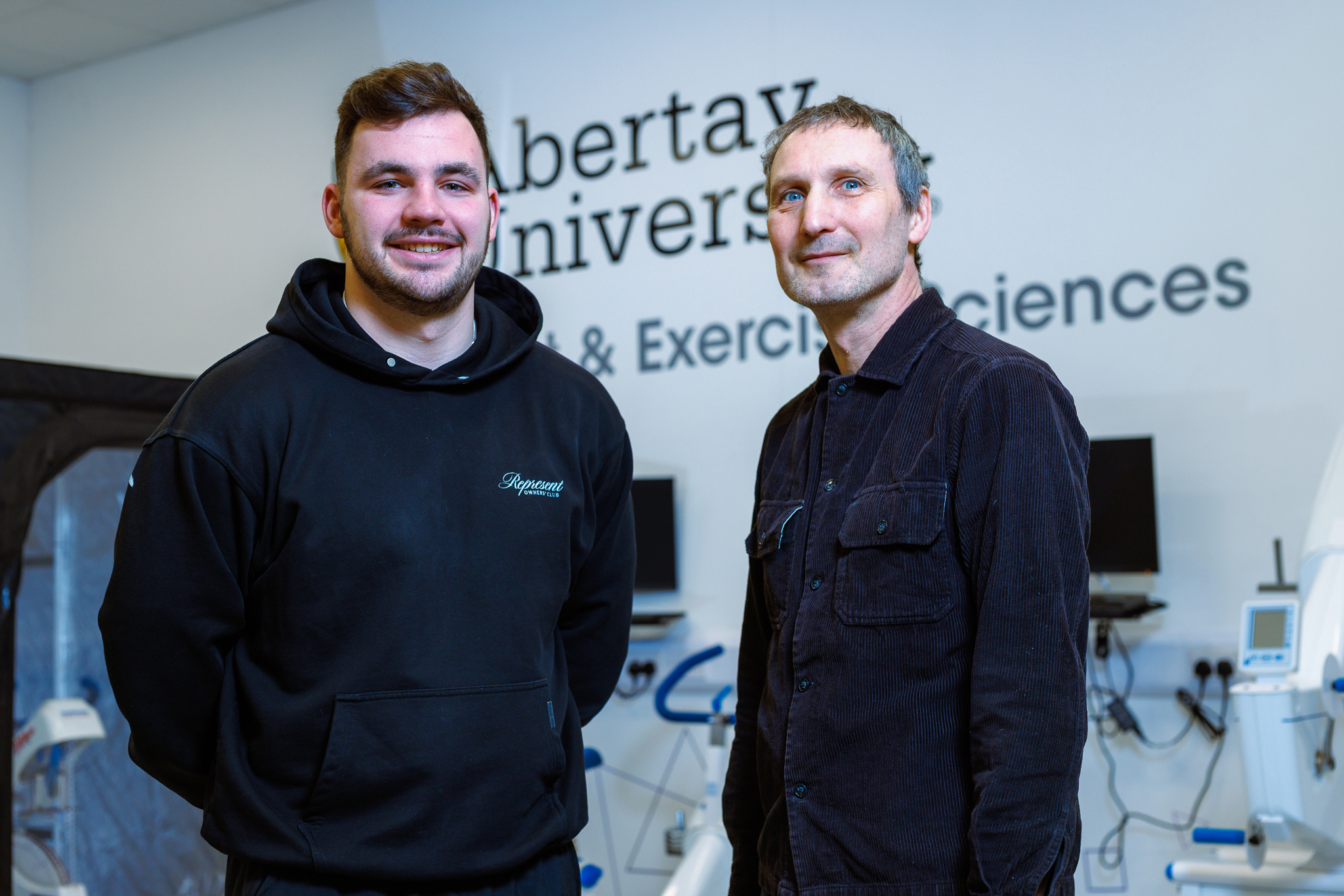
The project was led by sports scientists Dr Andrew Usher and Dr John Babraj, together with 4th year Abertay University Sport and Exercise Science student Adam Younger.
The Perth club provided access to first-team players and supported the applied testing environment.
Dr Andrew Usher, lead author of the study and a visiting research fellow at Abertay University, said:
Repeated sprinting is central to modern football, but our findings show that not all muscles cope equally with these demands. The hamstring’s slower recovery could be a key factor in why it is so frequently injured. Understanding these differences gives coaches and medical teams a clearer target for conditioning and injury prevention work.
Dr John Babraj, co-author and senior lecturer in Exercise Physiology at Abertay, added:
Our findings show that muscle oxygen use is strongly related to sprint performance, and that we may not currently be conditioning players to allow them to thrive in the modern game. This could help explain why hamstring injuries have increased so much over the last 30 years. Using technology like NIRS offers us the opportunity to study muscle performance in situ and explore the internal demands being placed on elite athletes. This allows us to train athletes to better meet the demands of football and therefore reduce the risk of injury occurring.
Abertay student Adam Younger said:
My involvement in the data gathering and analysis phases of this project provided a valuable insight into a new area of physiology and highlighted the importance of research in driving adaptation in sport. Contributing to a published study and assisting with testing within a professional football environment was a highly rewarding experience for me as a student. Taking part in this study has also allowed me to progress into further internship opportunities within other professional clubs.
*St Johnstone FC photos supplied by Perthshire Picture Agency*


